Democracy is fun!? @ Art Quarter Budapest, project space, 01.03. - 14.03.2026
Opening 28.2. - 18:00 with a long-duration performance by Viktória Monhor (nest)
Finissage 14.3. 18:00 with a curators tour & an interactive audiovisual piece by Klaus Obermaier
Opening 28.2. - 18:00 with a long-duration performance by Viktória Monhor (nest)
Finissage 14.3. 18:00 with a curators tour & an interactive audiovisual piece by Klaus Obermaier
Democracy is fun!? @ Austrian Cultural Forum Budapest, 19.03. - 22.04.2026
Opening 19.03. - 18:00 with a discussion of work by Levente Zsigmond Hajdu, Maria Kracíková, Holger Lang, Viktória Monhor and Martina Tritthart
Opening 19.03. - 18:00 with a discussion of work by Levente Zsigmond Hajdu, Maria Kracíková, Holger Lang, Viktória Monhor and Martina Tritthart
Democratic systems around the world are under growing pressure. Civil rights and opportunities for
political participation are becoming more limited, while authoritarian models are gaining influence,
and corporations are playing a stronger role in political decision-making. Democracy is fun!?,
a project by the Austrian artist collective mutual loop, explores the fragility of democracy in
today’s political, social, and media environments. As an exhibition and discursive platform,
it examines how democratic processes are presented, negotiated, and challenged.
political participation are becoming more limited, while authoritarian models are gaining influence,
and corporations are playing a stronger role in political decision-making. Democracy is fun!?,
a project by the Austrian artist collective mutual loop, explores the fragility of democracy in
today’s political, social, and media environments. As an exhibition and discursive platform,
it examines how democratic processes are presented, negotiated, and challenged.
Developed as a transnational curatorial project, the exhibition responds to tensions shaping democratic
societies in Europe, including nationalism, disinformation, political polarisation, and declining public trust.
It presents art as a space for public encounter, critical thinking, and shared reflection. Through participatory,
multimedia, and immersive works, visitors are encouraged to move beyond passive viewing and engage
with questions of power, representation, dissent, and responsibility. Democracy is understood as an
ongoing process that must be continually experienced, questioned, and renegotiated. The first edition
of Democracy is Fun! took place in August 2025 in Sfântu Gheorghe, Romania. The second edition brings
selected works to Art Quarter Budapest and the Austrian Cultural Forum Budapest alongside existing works
and newly commissioned pieces by European artists. Featuring artists from Hungary, Austria, Germany,
Czech Republic and Ireland, the exhibition forms part of a broader European conversation. The artist-duo
mutual loop acts both as contributors and curators, intentionally blurring boundaries between artistic
and curatorial roles. The added question mark in the title signals a shift: democracy is presented as
an open question shaped by uncertainty and lived experience. A key element is the Speakers’ Corner,
a space within the exhibition where visitors can speak (or write) publicly. This format draws on the
historical tradition of Speakers’ Corners, especially in England, where public speaking became a symbol
of free expression and civic participation. In the exhibition, it functions as an active framework that
invites visitors to test their voice and reflect on the possibilities and risks of public expression.
societies in Europe, including nationalism, disinformation, political polarisation, and declining public trust.
It presents art as a space for public encounter, critical thinking, and shared reflection. Through participatory,
multimedia, and immersive works, visitors are encouraged to move beyond passive viewing and engage
with questions of power, representation, dissent, and responsibility. Democracy is understood as an
ongoing process that must be continually experienced, questioned, and renegotiated. The first edition
of Democracy is Fun! took place in August 2025 in Sfântu Gheorghe, Romania. The second edition brings
selected works to Art Quarter Budapest and the Austrian Cultural Forum Budapest alongside existing works
and newly commissioned pieces by European artists. Featuring artists from Hungary, Austria, Germany,
Czech Republic and Ireland, the exhibition forms part of a broader European conversation. The artist-duo
mutual loop acts both as contributors and curators, intentionally blurring boundaries between artistic
and curatorial roles. The added question mark in the title signals a shift: democracy is presented as
an open question shaped by uncertainty and lived experience. A key element is the Speakers’ Corner,
a space within the exhibition where visitors can speak (or write) publicly. This format draws on the
historical tradition of Speakers’ Corners, especially in England, where public speaking became a symbol
of free expression and civic participation. In the exhibition, it functions as an active framework that
invites visitors to test their voice and reflect on the possibilities and risks of public expression.
Supported by the Austrian Ministry of Foreign Affairs and the Austrian Cultural Forum in Budapest.
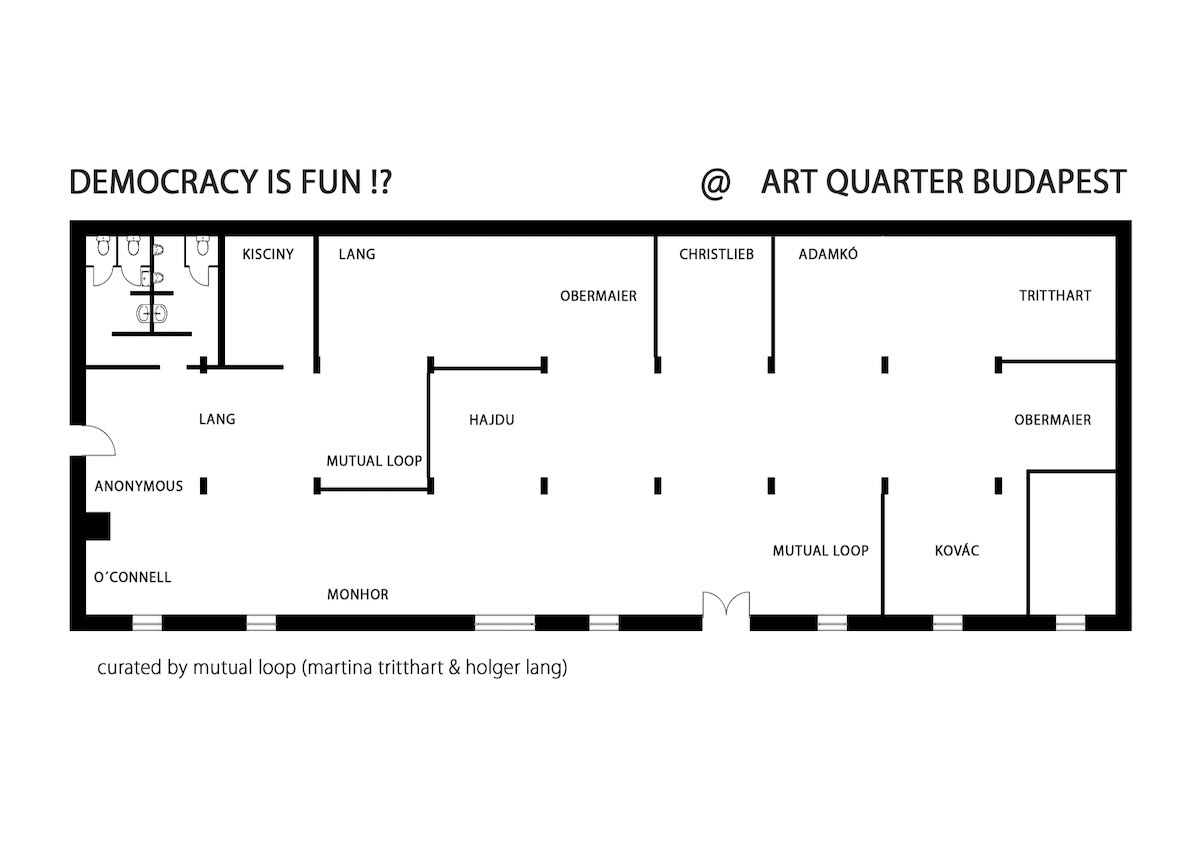
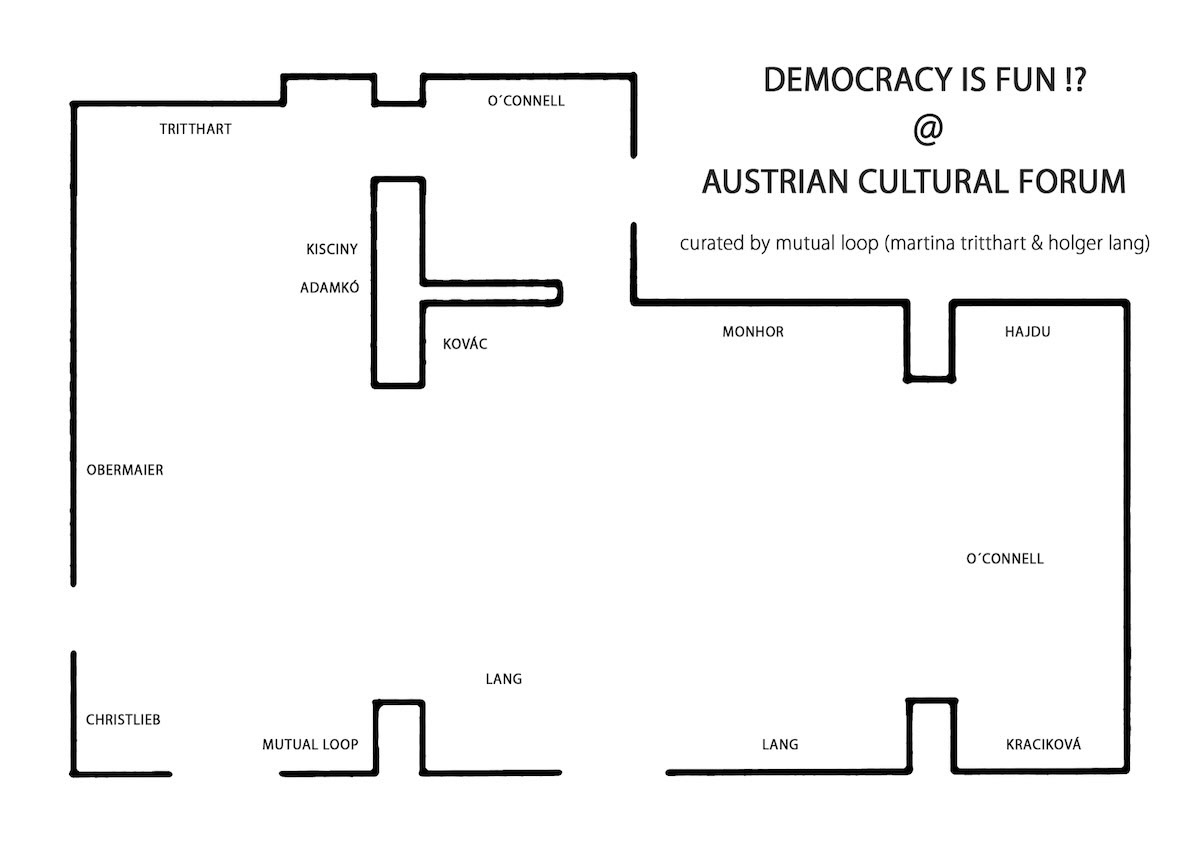
PARTICIPATING ARTISTS
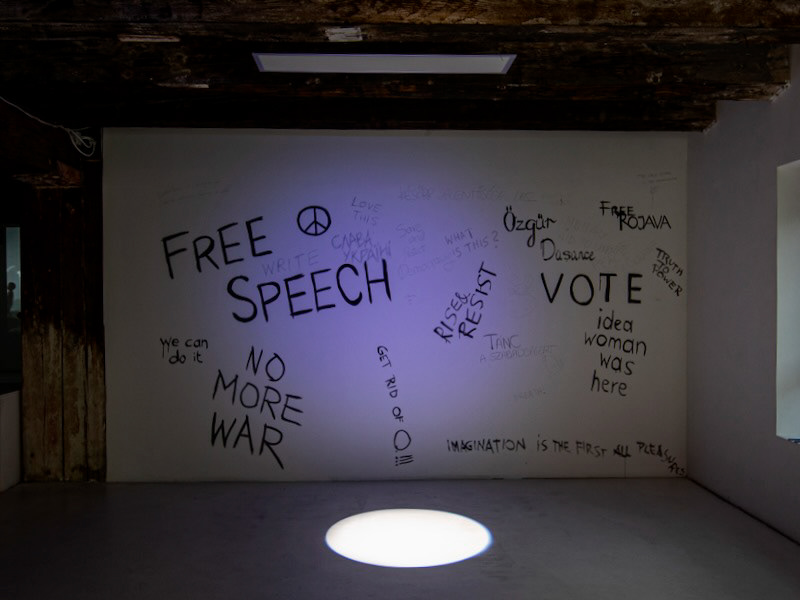
mutual loop - Speakers‘ Corner
A central element is the Speakers’ Corner, a space within the exhibition where visitors can speak publicly. This format draws on the historical tradition of Speakers’ Corners, especially in England, where public speaking became a symbol of free expression and civic participation. In the exhibition, it functions as an active framework that invites visitors to test their voice and reflect on the possibilities and risks of public expression. Visitors are also invited to write on the walls using provided markers, sharing their thoughts on democracy, society, the future, and art.
A central element is the Speakers’ Corner, a space within the exhibition where visitors can speak publicly. This format draws on the historical tradition of Speakers’ Corners, especially in England, where public speaking became a symbol of free expression and civic participation. In the exhibition, it functions as an active framework that invites visitors to test their voice and reflect on the possibilities and risks of public expression. Visitors are also invited to write on the walls using provided markers, sharing their thoughts on democracy, society, the future, and art.
RAINBOW (@ AQB)
Three spotlights, red, white, and green, cast overlapping fields of light across the space. Where they meet, colours shift, dissolve, and reappear. Additive mixing reveals that colour is never fixed; it emerges through relation, proximity, and shared presence. Shadows, too, become multiple. They are not simply absence, but traces of difference, places where light is redirected rather than lost. Within the context of Democracy is fun, the installation reflects on how systems define visibility. National colours promise unity, yet their dominance can narrow the spectrum of what is seen. Other colours persist in the shadows: present, but less acknowledged. By making colored shadows visible, the work proposes a simple proposition: democracy, like light, is relational. What appears depends on who stands together, who is illuminated, and who remains partially obscured, waiting to be recognised as part of the whole spectrum.
Three spotlights, red, white, and green, cast overlapping fields of light across the space. Where they meet, colours shift, dissolve, and reappear. Additive mixing reveals that colour is never fixed; it emerges through relation, proximity, and shared presence. Shadows, too, become multiple. They are not simply absence, but traces of difference, places where light is redirected rather than lost. Within the context of Democracy is fun, the installation reflects on how systems define visibility. National colours promise unity, yet their dominance can narrow the spectrum of what is seen. Other colours persist in the shadows: present, but less acknowledged. By making colored shadows visible, the work proposes a simple proposition: democracy, like light, is relational. What appears depends on who stands together, who is illuminated, and who remains partially obscured, waiting to be recognised as part of the whole spectrum.
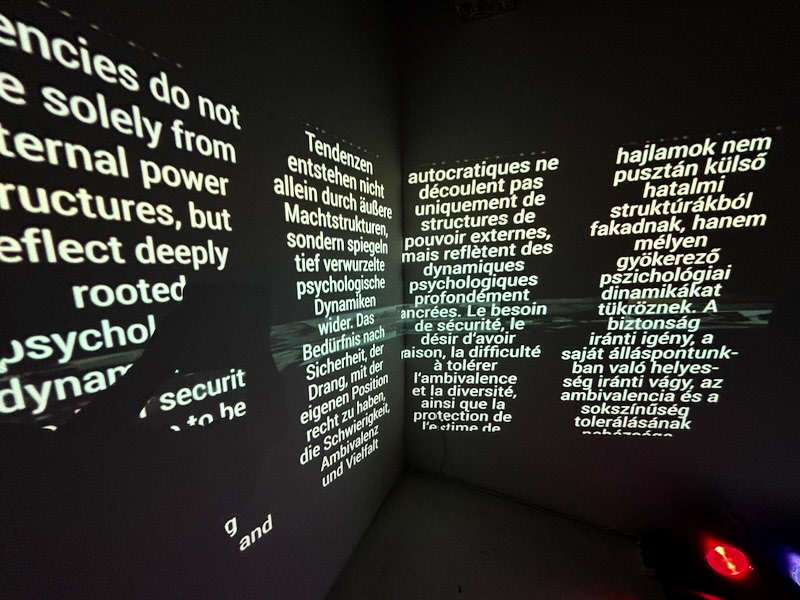
Holger Lang - SCROLL (video projection / installation)
A collage of scrolling screens and a text about the connection between the individual emotional and psychological backgrounds of people and their potential relation to the rise of authoritarian structures and ideas.
A collage of scrolling screens and a text about the connection between the individual emotional and psychological backgrounds of people and their potential relation to the rise of authoritarian structures and ideas.
ALL OF US (video projection / installation)
The video installation, produced with cost-free AI models, reflects on the responsibilities of individuals and society amid social, ecological, and technological upheaval, emphasising the centrality of democracy, human dignity, and cultural freedom. It highlights the roles of art, solidarity, and fair structures in sustaining inclusive, resilient societies, while warning that unregulated AI and inequality pose critical challenges to social cohesion and democratic participation.
The video installation, produced with cost-free AI models, reflects on the responsibilities of individuals and society amid social, ecological, and technological upheaval, emphasising the centrality of democracy, human dignity, and cultural freedom. It highlights the roles of art, solidarity, and fair structures in sustaining inclusive, resilient societies, while warning that unregulated AI and inequality pose critical challenges to social cohesion and democratic participation.
CV: Holger Lang is an Austrian artist, filmmaker, curator, and researcher based in Vienna. His work spans abstract and conceptual projects as well as experimental and interdisciplinary approaches. For 30 years, he taught animation, media arts, and aesthetics at the Austrian satellite campus of an American university and its main campus in Missouri. He is the founder and director of the "Under-the-Radar" media art and animation festival and the "Sternstudio" gallery, both in Vienna. He is a board member of ASIFA Austria and the Künstlerhaus Vereinigung.
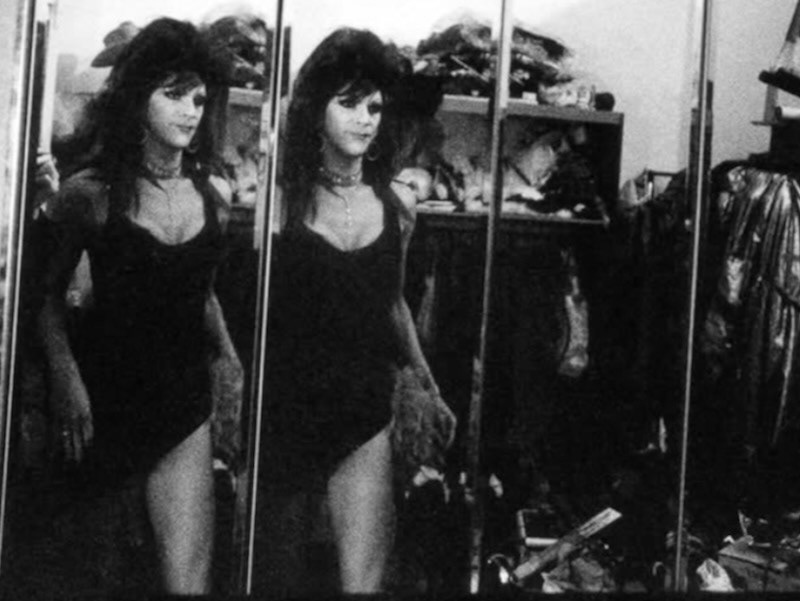
Maria Kracíková - Gloria / from the series: My Berlin, 2003–2008
120 x 80 cm, giclée print, analog photography - This photograph is part of my project "My Berlin," which became a kind of diary entry for me. At the time, I primarily photographed at night, engaging with the city in a waking-dream state. In 2005, I was working on a major photo essay for a newspaper and met Michael, also known as Gloria. Drag queen Gloria Viagra was already a well-known figure in Berlin's nightlife. I visited Michael at his home before his show and watched him transform into Gloria. I was deeply moved by how a large man became a delicate woman. In the end, I even felt a strong urge to carry her suitcase for the show.
120 x 80 cm, giclée print, analog photography - This photograph is part of my project "My Berlin," which became a kind of diary entry for me. At the time, I primarily photographed at night, engaging with the city in a waking-dream state. In 2005, I was working on a major photo essay for a newspaper and met Michael, also known as Gloria. Drag queen Gloria Viagra was already a well-known figure in Berlin's nightlife. I visited Michael at his home before his show and watched him transform into Gloria. I was deeply moved by how a large man became a delicate woman. In the end, I even felt a strong urge to carry her suitcase for the show.
CV: Born in 1973 in Hořice, Czech Republic, Maria Kracikova studied photography at FAMU Prague and the Berlin University of the Arts (UdK). Her work “Romano maro” won, among other awards, first prize at the Golden Eye / Czech Press Photo Award 2000, and was published as a photobook of the same name (“Romano maro,” published by Galerie Pecka, Prague) in 2002. Kracikova lives and works as an artistic photographer in Vienna. Her work explores the role of women in patriarchal society, feminism, and activism in art. Her current series include “Poems of Vanishing” and “Strike!”
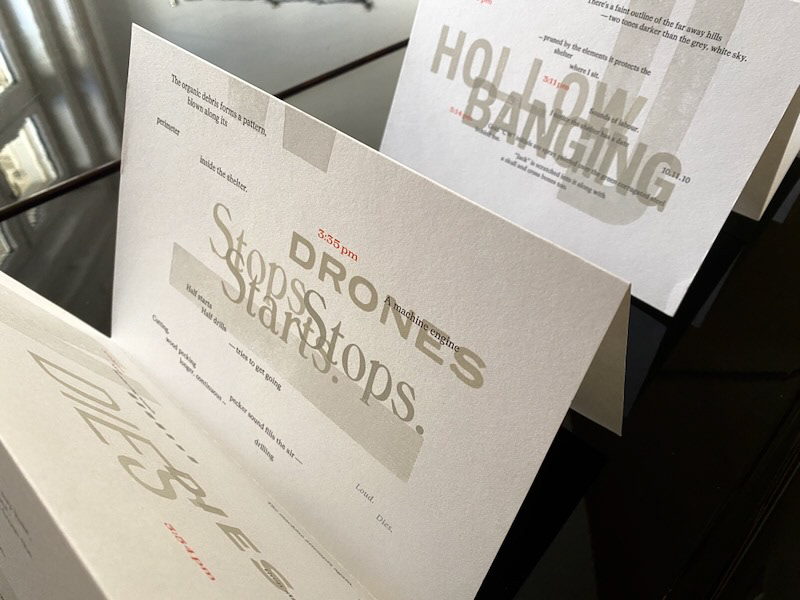
Pauline O ‘Connell - tHERE (with Ellen Martin-Friel) - Artist’s Book, 2025
Designed, typeset and printed by Ellen Martin-Friel on a Western-style Double Crown proofing press at Distillers Press, Dublin. Type used is various wood types from the cases at Distillers Press. Metal type is Magister 12d Roman, Italic and Bold Extended designed in 1966 by Aldo Novarese at the Società Nebiolo Foundry, on loan from The Salvage Press. The paper used is 180 gsm Fedrigoni Materica. Housed in cloth-covered and Fedrigoni Sirio lined solander boxes, handcrafted by Elize de Beer at her studio in Cork City. Additional Notes & Colophon pages are printed on Zerkall Ingres. Printed in an edition of 75 numbered copies, signed by both collaborators.
Designed, typeset and printed by Ellen Martin-Friel on a Western-style Double Crown proofing press at Distillers Press, Dublin. Type used is various wood types from the cases at Distillers Press. Metal type is Magister 12d Roman, Italic and Bold Extended designed in 1966 by Aldo Novarese at the Società Nebiolo Foundry, on loan from The Salvage Press. The paper used is 180 gsm Fedrigoni Materica. Housed in cloth-covered and Fedrigoni Sirio lined solander boxes, handcrafted by Elize de Beer at her studio in Cork City. Additional Notes & Colophon pages are printed on Zerkall Ingres. Printed in an edition of 75 numbered copies, signed by both collaborators.
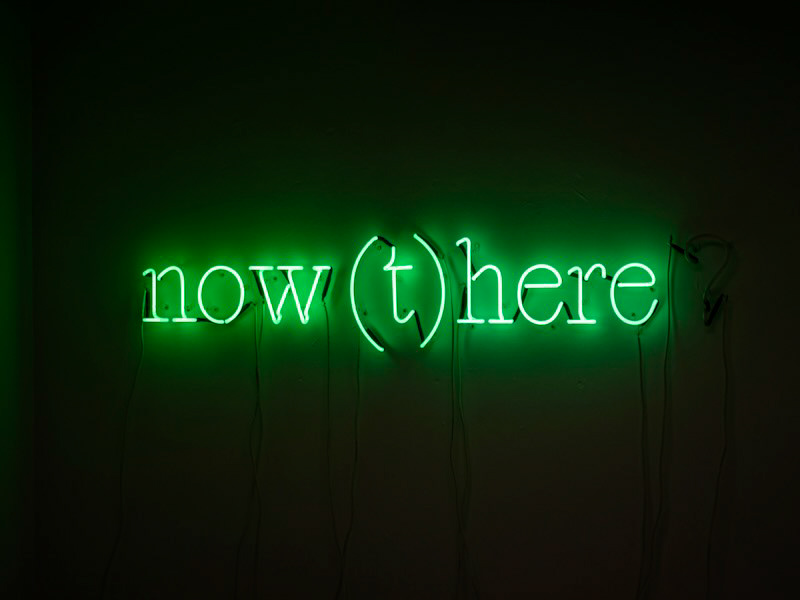
(T)HERE, neon lights, 2021
Pauline O’Connell’s neon installation (t)here explores the instability of presence, location, and perception through the minimal transformation of language. Composed as a green illuminated text whose letters activate in shifting sequences here, W....here?, now (t)here, here? the work continuously repositions the viewer between certainty and uncertainty, arrival and displacement. The subtle insertion of the parenthetical “(t)” destabilises the immediacy of “here,” suggesting that presence is never fixed but always contingent, deferred, or in transition. By employing the visual authority of commercial neon signage while undermining its directive clarity, O’Connell creates a spatial and linguistic threshold that prompts viewers to reconsider where they stand, when they are present, and how meaning emerges through the smallest textual shifts.
Pauline O’Connell’s neon installation (t)here explores the instability of presence, location, and perception through the minimal transformation of language. Composed as a green illuminated text whose letters activate in shifting sequences here, W....here?, now (t)here, here? the work continuously repositions the viewer between certainty and uncertainty, arrival and displacement. The subtle insertion of the parenthetical “(t)” destabilises the immediacy of “here,” suggesting that presence is never fixed but always contingent, deferred, or in transition. By employing the visual authority of commercial neon signage while undermining its directive clarity, O’Connell creates a spatial and linguistic threshold that prompts viewers to reconsider where they stand, when they are present, and how meaning emerges through the smallest textual shifts.
CV: Pauline O'Connell is an Irish multidisciplinary artist working across film, photography, sculpture, installation, text, and sound. She studied sculpture and photography at IADT (1993) and holds a first-class MA in Social Practice from Limerick School of Art (2012). She is completing a practice-led PhD at the University of Amsterdam titled Paradox Not Paradise: The Rural as Site of Representational Struggle. Over a thirty-year career, her work has focused on micro-histories and personal narratives, often developed within the communities where they originate. Her projects create connections between art and lived experience and have been exhibited and commissioned internationally, including in London, Paris, Vienna, the USA, and across Ireland in both gallery and public contexts.
Levente Zsigmond Hajdu - Elmúlik - Fade, installation, documentation
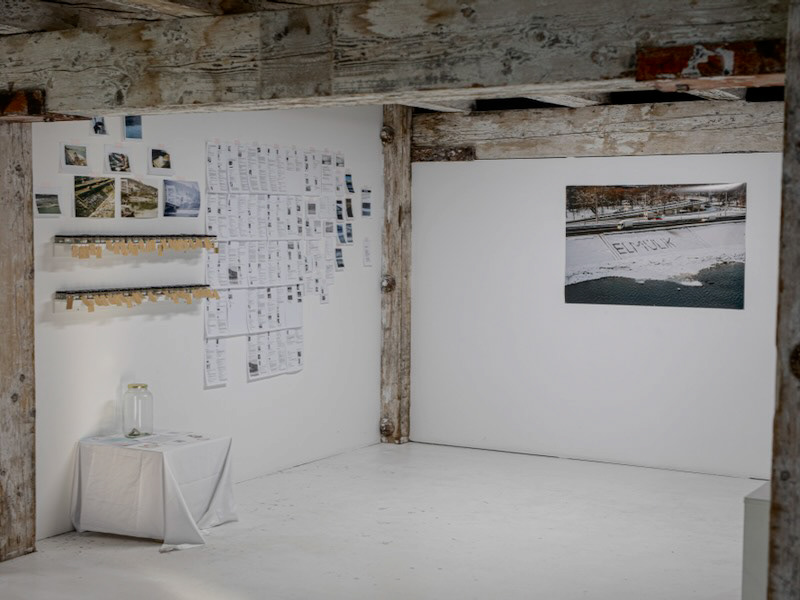
In January 2026, on the snow-covered banks of the Danube, the word ELMÚLIK - Hungarian for FADE - was written without announcement or audience. Exposed to weather, time, and disappearance, the gesture existed as a temporary inscription. Before the word dissolved, the snow was gathered and divided into one hundred small glasses, forming an archive of impermanence. Presented as an installation, the one hundred glasses operate simultaneously as sculpture and distributed artwork: each glass can circulate beyond the exhibition. Proceeds support the pilot phase of the first Hungarian Cultural Basic Income initiative, linking ephemerality to questions of artistic labour and economic conditions. The work extends Hajdu’s ongoing interest in the tension between material and immaterial states, as well as his engagement with the idea of universal basic income for artists. The transformation from landscape gesture to collectable object foregrounds time, disappearance, and value, while reframing fading not as loss but as redistribution. Elmúlik - Fade positions impermanence as both an aesthetic strategy and a social proposition, in which memory, documentation, and circulation become the lasting form of a work destined to vanish.
In January 2026, on the snow-covered banks of the Danube, the word ELMÚLIK - Hungarian for FADE - was written without announcement or audience. Exposed to weather, time, and disappearance, the gesture existed as a temporary inscription. Before the word dissolved, the snow was gathered and divided into one hundred small glasses, forming an archive of impermanence. Presented as an installation, the one hundred glasses operate simultaneously as sculpture and distributed artwork: each glass can circulate beyond the exhibition. Proceeds support the pilot phase of the first Hungarian Cultural Basic Income initiative, linking ephemerality to questions of artistic labour and economic conditions. The work extends Hajdu’s ongoing interest in the tension between material and immaterial states, as well as his engagement with the idea of universal basic income for artists. The transformation from landscape gesture to collectable object foregrounds time, disappearance, and value, while reframing fading not as loss but as redistribution. Elmúlik - Fade positions impermanence as both an aesthetic strategy and a social proposition, in which memory, documentation, and circulation become the lasting form of a work destined to vanish.
CV: Levente Zsigmond Hajdu (born 1991) studied Film Theory and Aesthetics at ELTE Budapest (2011–2018) and completed a BA in Media Design at Moholy-Nagy University of Art and Design (2013–2017). In 2016, he studied Fine Art at Villa Arson in Nice. Between 2019 and 2022, he studied Philosophy at Babeș-Bolyai University in Cluj and continued his studies at Université Paris Panthéon-Sorbonne in 2020. In 2023- 2024, he participated in international residency programs in Zagreb (Slobodne Veze) and Belgrade (Footnote). In 2022, he received a Special Award at the 67th Hungarian Independent Film Review in Szabadka. His solo exhibitions have been presented at FKSE Budapest (2022–2024), Footnote Belgrade (2024), and other independent art spaces. Notable solo projects include Prize spiral (FKSE, 2022/2024), Bag-show (Footnote, 2024), and I don’t think we should talk anymore (FKSE, 2022). His work has also been shown in group exhibitions and film festivals.
Viktória Monhor - What’s New?, performance, 30', 2026
Fragile Balance (Danger) exhibition opening, Trafó Gallery, Trafó House of Contemporary Arts
Concept, performer: Viktória Monhor, Consultant: Tamás Ördög
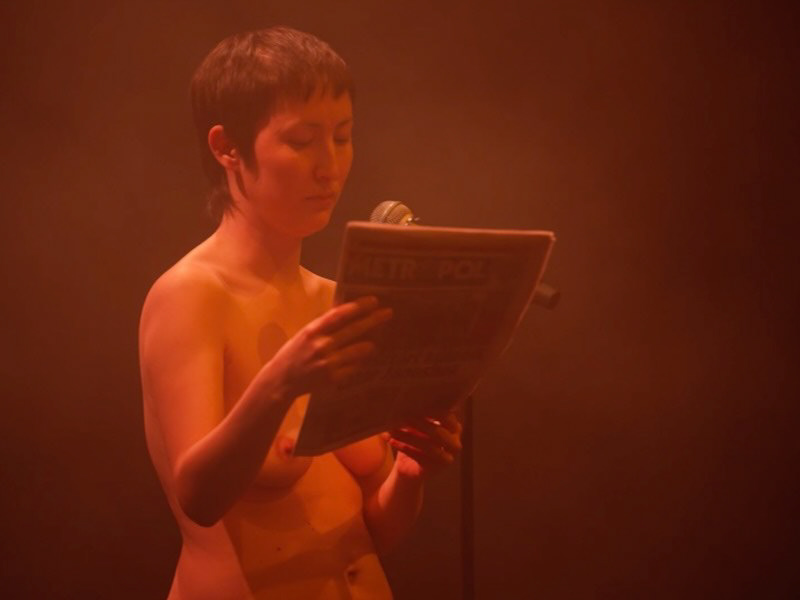
What’s new? – a familiar-sounding, frequently asked question. But thinking more deeply about it: really, what’s new? How are you? Does it matter what the news says? And what kind of news, anyway? A thought experiment on speech situations and the possibilities of storytelling.
Fragile Balance (Danger) exhibition opening, Trafó Gallery, Trafó House of Contemporary Arts
Concept, performer: Viktória Monhor, Consultant: Tamás Ördög
What’s new? – a familiar-sounding, frequently asked question. But thinking more deeply about it: really, what’s new? How are you? Does it matter what the news says? And what kind of news, anyway? A thought experiment on speech situations and the possibilities of storytelling.
List. / Playlist. , performance, 70', 2026
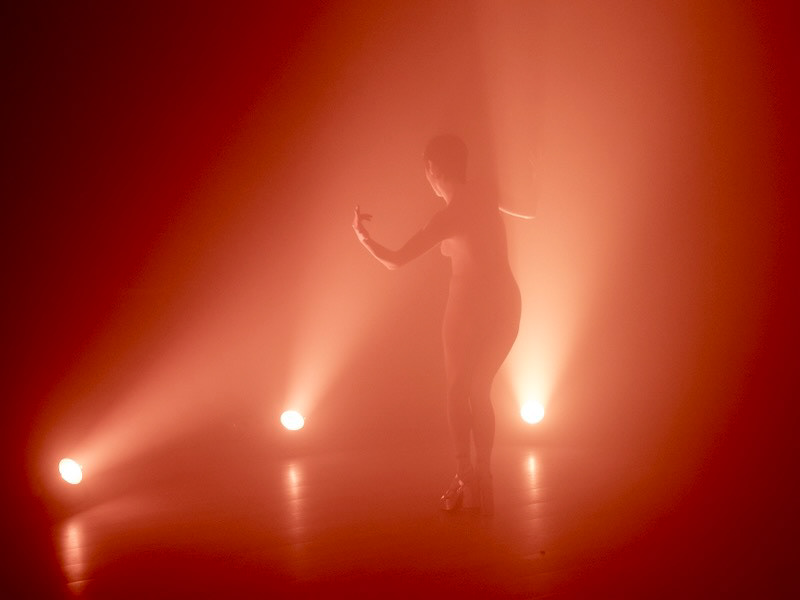
In the long-durational performance List. / Playlist., the performer dances to iconic pop songs associated with favourites of the current Hungarian political system (so-called NER) in an orange, fog-filled space. Appearing naked and fully committed, the performer continues for as long as possible, pushing the body toward exhaustion.
The work frames endurance as a gesture of protest. Strain, repetition, and fatigue become forms of resistance, transforming vulnerability into a visible political statement. The performance is developed in collaboration with Tamás Ördög, who acts as a consultant. Ördög is the founder of the progressive independent Hungarian troupe Dollár Papa Gyermekei (Children of Dollar Daddy), as well as an actor and director. The collaboration builds on earlier joint work, including the lecture performance What’s New?, which similarly explored provocative performative strategies and the relationship between art, politics, and public discourse. The performance takes place on the opening evening of the exhibition, 28 February 2026, at 18:30, in the space “Nest” at Art Quarter Budapest. In the exhibition, the performance is presented through a silent video documentation. The songs used in the performance are made available as printed lyrics on postcards, which visitors can freely take with them.
In the long-durational performance List. / Playlist., the performer dances to iconic pop songs associated with favourites of the current Hungarian political system (so-called NER) in an orange, fog-filled space. Appearing naked and fully committed, the performer continues for as long as possible, pushing the body toward exhaustion.
The work frames endurance as a gesture of protest. Strain, repetition, and fatigue become forms of resistance, transforming vulnerability into a visible political statement. The performance is developed in collaboration with Tamás Ördög, who acts as a consultant. Ördög is the founder of the progressive independent Hungarian troupe Dollár Papa Gyermekei (Children of Dollar Daddy), as well as an actor and director. The collaboration builds on earlier joint work, including the lecture performance What’s New?, which similarly explored provocative performative strategies and the relationship between art, politics, and public discourse. The performance takes place on the opening evening of the exhibition, 28 February 2026, at 18:30, in the space “Nest” at Art Quarter Budapest. In the exhibition, the performance is presented through a silent video documentation. The songs used in the performance are made available as printed lyrics on postcards, which visitors can freely take with them.
CV: Viktória Monhor (born 1989): Most of Viktória Monhor’s works are reflections on Hungarian social, political and public topics, mostly through the medium of performance. She considers artistic activity as an extended social practice that, as a field of free thinking, can articulate a critical attitude. Including her dual identity arising from her family roots, as well as personal and family life situations in the creative process, constitutes another pillar of her artistic practice. She considers the “official” artistic profession, the existence of an artist, insofar as it is not applied arts and works of a decorative nature, to be a kind of statement due to the existential unpredictability undertaken with it.
Máté Kovács - Life Drawing, video 2016/2026, 10 min
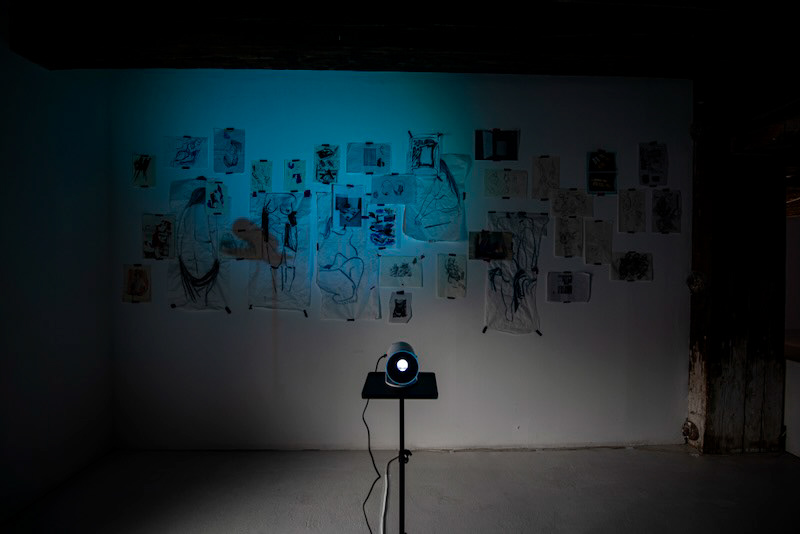
The project brings together a documentary film, drawings, and a sculpture — a bust of the artist’s own head — to examine the body as both subject and institutional construct. The video stems from a side story of institutional change ten years ago, when life models at the Hungarian University of Fine Arts attempted to form a labour union. As the initiative could not be legally realised, the collective body remained without official form. Referencing the tradition of academic life drawing, where the nude serves as a tool for studying anatomy and perception, the work shifts focus from physical structure to social structure. Rather than analysing muscles and bones, it explores how bodies function within institutional systems — how they are organised, regulated, and made visible or invisible. Through documentary material, drawings, and sculptural self-representation, the project traces the tension between individual presence and collective representation, positioning the body as a site where artistic education, labour, and institutional power intersect.
The project brings together a documentary film, drawings, and a sculpture — a bust of the artist’s own head — to examine the body as both subject and institutional construct. The video stems from a side story of institutional change ten years ago, when life models at the Hungarian University of Fine Arts attempted to form a labour union. As the initiative could not be legally realised, the collective body remained without official form. Referencing the tradition of academic life drawing, where the nude serves as a tool for studying anatomy and perception, the work shifts focus from physical structure to social structure. Rather than analysing muscles and bones, it explores how bodies function within institutional systems — how they are organised, regulated, and made visible or invisible. Through documentary material, drawings, and sculptural self-representation, the project traces the tension between individual presence and collective representation, positioning the body as a site where artistic education, labour, and institutional power intersect.
CV: Máté Kovács (born 1993) is a Budapest-based visual artist who studied at the Hungarian University of Fine Arts (2014–2020). His practice spans drawing, installation, and conceptual approaches that explore perception, language, and systems of thought. He has exhibited in Budapest and internationally, including at Labour Gallery, Horizont Gallery, Artus Gallery, Clark Fyfe Gallery (Glasgow), and aqb MINES, and participated in exchange and residency programs in Glasgow and Istanbul. His work has been featured in Artmagazin, Artportal, and Újművészet. He received the Ludwig Foundation Scholarship (2018) and the Decode Promising Project Award (2023, with Ádám Takács), and also writes on contemporary art.
Martina Tritthart - un sichtbar (in visible), 1min 24, A 2020 (@ ACF)
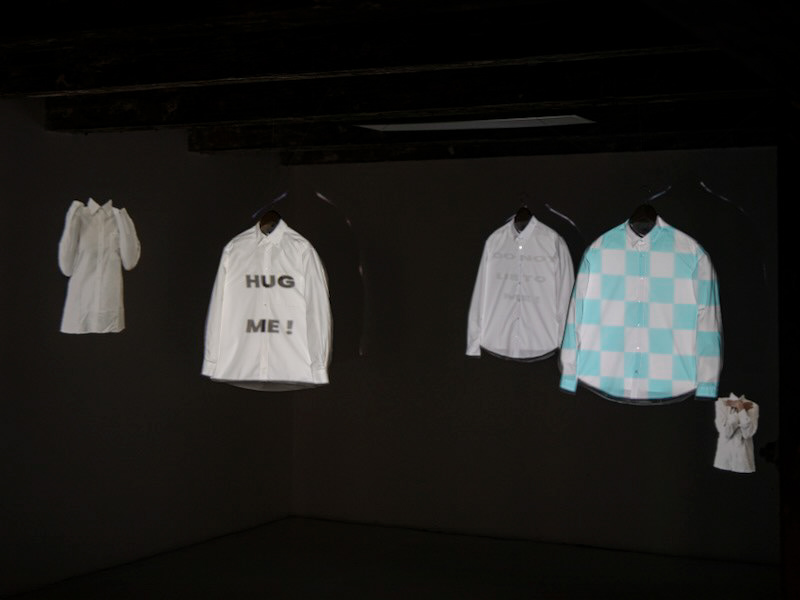
The short animation film un sichtbar (in visible) is part of the multi-channel video projection do (not) ignore me. A white shirt whose sleeves jerk rapidly up and down, or disembodied hands that gently stroke the torso before vanishing again. The white shirt operates as a mutable signifier: at once workwear, uniform, and a surface of projection. It evokes neutrality and standardization, something meant to erase individuality, gender, and authorship, while simultaneously pointing to the bodies that inhabit and sustain systems yet remain unacknowledged. As a garment, it both reveals and conceals: it frames the body, but also masks it, enabling a form of disappearance in plain sight. The work thus oscillates between presence and erasure, intimacy and detachment, asking how bodies, especially those coded as neutral, compliant, or service-oriented, are rendered perceptible or remain unseen within social, economic, and artistic frameworks.
The short animation film un sichtbar (in visible) is part of the multi-channel video projection do (not) ignore me. A white shirt whose sleeves jerk rapidly up and down, or disembodied hands that gently stroke the torso before vanishing again. The white shirt operates as a mutable signifier: at once workwear, uniform, and a surface of projection. It evokes neutrality and standardization, something meant to erase individuality, gender, and authorship, while simultaneously pointing to the bodies that inhabit and sustain systems yet remain unacknowledged. As a garment, it both reveals and conceals: it frames the body, but also masks it, enabling a form of disappearance in plain sight. The work thus oscillates between presence and erasure, intimacy and detachment, asking how bodies, especially those coded as neutral, compliant, or service-oriented, are rendered perceptible or remain unseen within social, economic, and artistic frameworks.
DO (NOT) IGNORE ME (@ AQB)
Martina Tritthart’s multi-channel video installation presents three suspended white men’s shirts onto which short films and text sequences are projected, turning the garments into stand-ins for absent bodies. Phrases such as do ignore me / do not ignore me and shifting variations like (not) hug me or (not) believe me appear and disappear across the fabric, expressing contradictory desires and the fragile dynamics of intimacy. A single negation repeatedly changes meaning, revealing how relationships are shaped by ambivalence and uncertainty. Colours and moving patterns pass over the shirts as if the material were breathing, registering emotion, tension, and memory. Occasional stop-motion animations, a shirt moving on its own or hands briefly touching a torso, introduce fragmented presences that are sensed but never fully visible. In this silent installation, projection becomes a form of displacement: the shirts speak for absent bodies and suggest inner conflict, expectation, and vulnerability. Tritthart stages clothing as both witness and screen, where unstable identities and emotional negotiations around intimacy, power, and self-representation become visible.
Martina Tritthart’s multi-channel video installation presents three suspended white men’s shirts onto which short films and text sequences are projected, turning the garments into stand-ins for absent bodies. Phrases such as do ignore me / do not ignore me and shifting variations like (not) hug me or (not) believe me appear and disappear across the fabric, expressing contradictory desires and the fragile dynamics of intimacy. A single negation repeatedly changes meaning, revealing how relationships are shaped by ambivalence and uncertainty. Colours and moving patterns pass over the shirts as if the material were breathing, registering emotion, tension, and memory. Occasional stop-motion animations, a shirt moving on its own or hands briefly touching a torso, introduce fragmented presences that are sensed but never fully visible. In this silent installation, projection becomes a form of displacement: the shirts speak for absent bodies and suggest inner conflict, expectation, and vulnerability. Tritthart stages clothing as both witness and screen, where unstable identities and emotional negotiations around intimacy, power, and self-representation become visible.
CV: Martina Tritthart is an artist, curator and researcher in Vienna and Klagenfurt, Austria. Her work includes installation and media-art as well as filmmaking. It has a prominent focus on light as a medium, particularly in relation to the perception of spaces. For her abstract animation film „solar mechanix 1.1“she received the Hubert Sielecki award. She completed her doctorate on "Light Spaces - Spatial Models of Perception" at Graz University of Technology and has been teaching since 1999. Currently, she is a postdoctoral fellow of the Master's program Visual Culture at the University of Klagenfurt.
Martha Kicsiny - OPERATIVE GAZE, 2020, 2 min 40
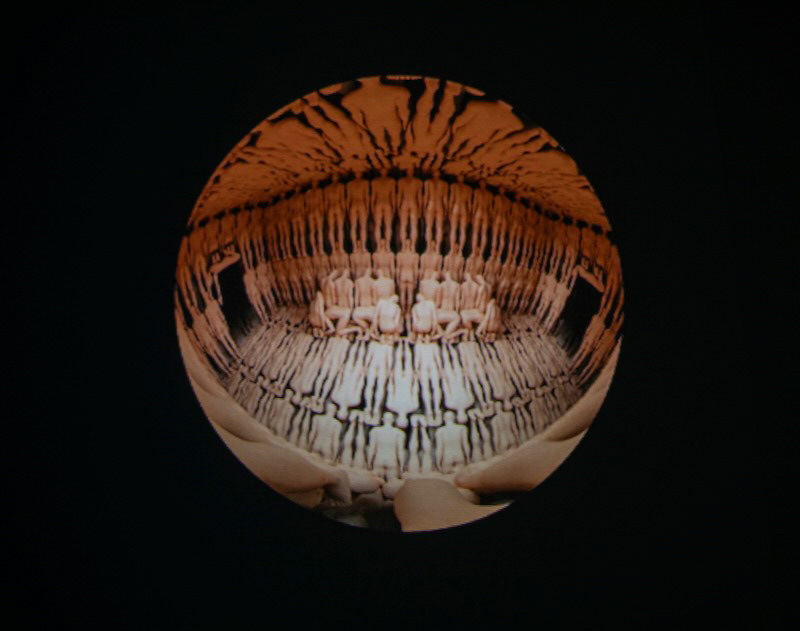
The video piece depicts a fictional surveillance agent interface that writes a report on a person by viewing live CCTV and bug camera footage. Viewers can see the live process of the report being made as the person moves through the places; they also become surveyors of the target. Then an error occurs, proposing the possibility of breaking out of such a system. The spaces visible are all formed by naked human bodies as a symbol of societies based on the exploitation of many for the comfort of the few privileged. Also, it gives a sense of a society where you can never feel alone and unobserved.
The work reflects on both current-day surveillance systems and the secret police system of the Soviet Bloc to understand the psychological dynamics between the surveiller and the surveyed in society.
The video piece depicts a fictional surveillance agent interface that writes a report on a person by viewing live CCTV and bug camera footage. Viewers can see the live process of the report being made as the person moves through the places; they also become surveyors of the target. Then an error occurs, proposing the possibility of breaking out of such a system. The spaces visible are all formed by naked human bodies as a symbol of societies based on the exploitation of many for the comfort of the few privileged. Also, it gives a sense of a society where you can never feel alone and unobserved.
The work reflects on both current-day surveillance systems and the secret police system of the Soviet Bloc to understand the psychological dynamics between the surveiller and the surveyed in society.
CV: Martha Kicsiny is a British-Hungarian visual artist based in Ghent, Belgium. She is a multimedia art fellow at the Doctorate School of the Moholy-Nagy Arts University (MOME, Budapest, Hungary). Her research aims to unearth and incorporate findings from 19th-century Media Archaeology into Contemporary Art, and especially Immersive Media discourses. Her artworks fuse predigital and digital techniques to understand the deep cultural traits from which our modern technology stems. Ranging from video art, site-specific installations, to 3D-printed lithophanes, her practice focuses on the human condition in society, the aftermath of historical events, the expression of power in architecture and the mythological origins of oppression and segregation.
Dávid Adamkó - TYRANNY, 2022, 12min
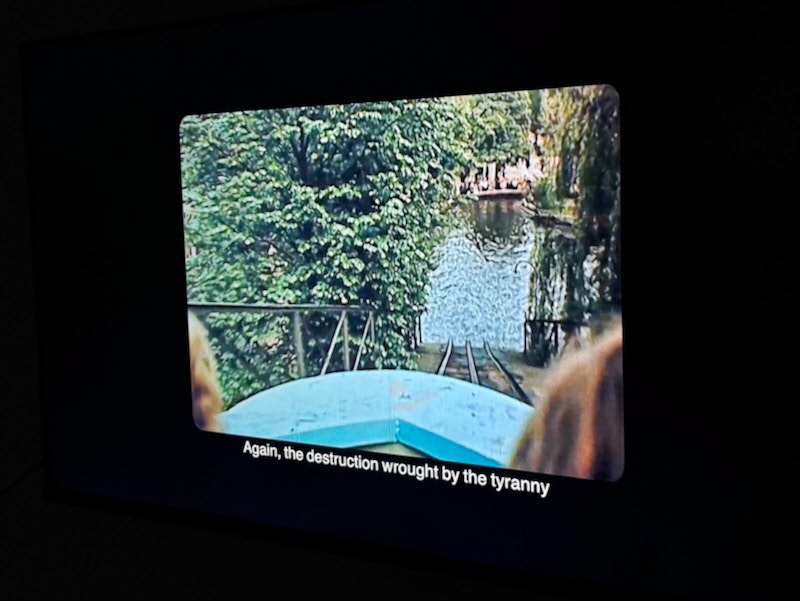
A dysfunctional society controlled by a toxic leader produces the contradictions of an illiberal state, with the European Union’s only autocratic member positioned at the forefront. In the film, an angular black hole appears in the centre of the nation’s main square, a public artwork that remains invisible to its citizens. Blending documentary and experimental strategies, the work documents and analyses this dark object as a metaphorical intervention and a quiet protest against autocracy. The black hole functions as a visual anchor through which the film reflects on anxiety, perception, and collective denial. Drawing on personal and historical experience, Adamko approaches tyranny not only as a political system but as a psychological condition shaped by long-term exposure to power, uncertainty, and historical memory. The analysis of this dark presence offers a brief yet pointed glimpse at tyranny from the perspective of anxiety.
A dysfunctional society controlled by a toxic leader produces the contradictions of an illiberal state, with the European Union’s only autocratic member positioned at the forefront. In the film, an angular black hole appears in the centre of the nation’s main square, a public artwork that remains invisible to its citizens. Blending documentary and experimental strategies, the work documents and analyses this dark object as a metaphorical intervention and a quiet protest against autocracy. The black hole functions as a visual anchor through which the film reflects on anxiety, perception, and collective denial. Drawing on personal and historical experience, Adamko approaches tyranny not only as a political system but as a psychological condition shaped by long-term exposure to power, uncertainty, and historical memory. The analysis of this dark presence offers a brief yet pointed glimpse at tyranny from the perspective of anxiety.
CV: Dávid Adamkó (born 1976, Debrecen, Hungary) studied at the Hungarian Academy of Arts and has exhibited widely in venues focusing on video and installation art. From 2012 to 2016, he founded and directed Higgs Field Project Space, an independent Budapest-based platform dedicated to experimental moving image and installation practices. His work reflects on political transformation in Central and Eastern Europe, shaped by experiences of late socialism, post-1989 democratisation, and contemporary illiberalism. Adamkó’s practice frequently explores anxiety, historical memory, and the psychological impact of long-term exposure to shifting systems of power. From this perspective, his work examines tyranny not only as a political structure but also as a condition that influences identity and collective experience.
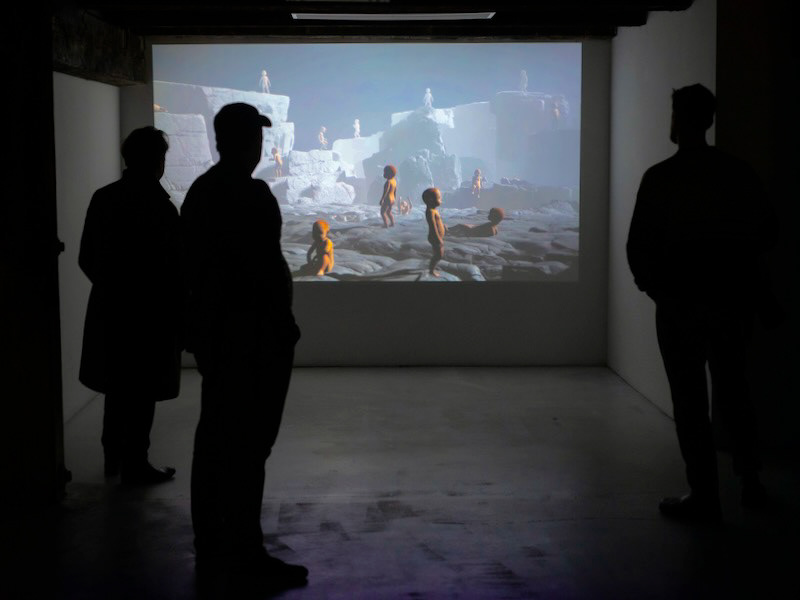
Klaus Obermaier - WAITING FOR THE END, 2022 (video excerpt from real-time rendered audiovisual installation) A never-ending pandemic. Putin starts a devastating war in Europe. Climate change is accelerating. Overpopulation, famine, soil sealing, depleted resources, unfair distribution of wealth, misery of refugees, etc. This work was created in January 2022, and events were catching up fast.
However, "Waiting for the End" is not only about catastrophes and dystopias but also questions the eternally repetitive, often senseless behaviours and actions of human beings.
WAITING FOR THE END is part of a series of artworks that place innocent childlike virtual characters in various social, political and humanistic contexts and environments.
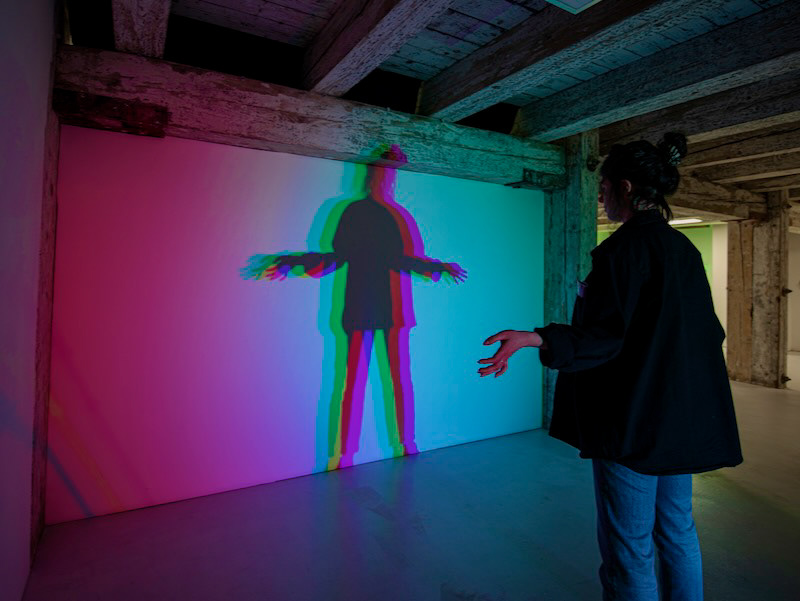
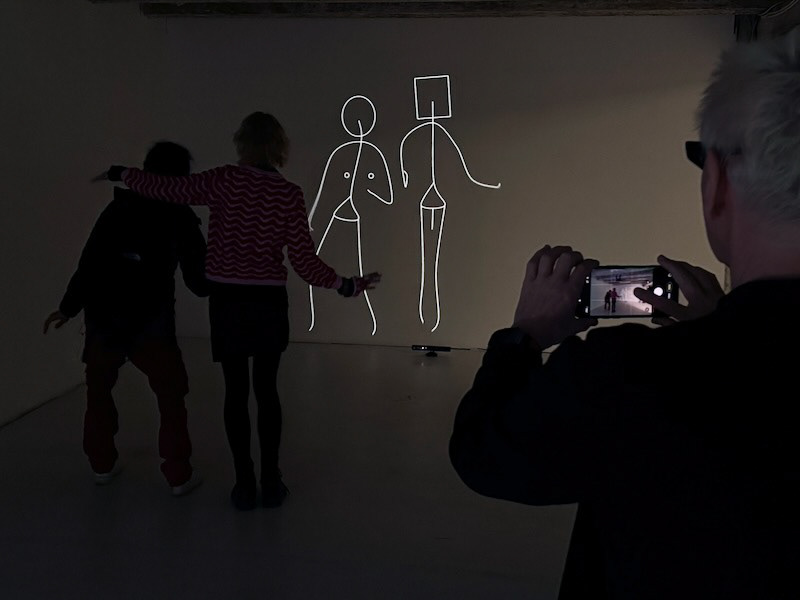
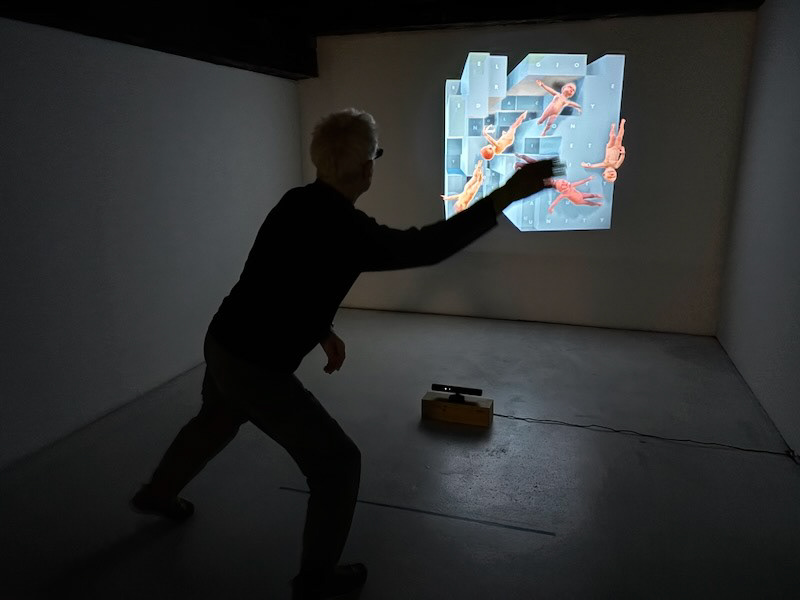
EGO (real-time rendered interactive installation since 2015) - (@ AQB)
In psychology, the mirror stage describes the formation of the Ego through objectification, in which the Ego results from a conflict between one's perceived visual appearance and one's emotional experience. This identification is what psychoanalyst Jacques Lacan called alienation. The interactive installation EGO re-stages and reverses the process of alienation by enhancing and deforming the mirror image through users' movements. Although an abstraction, it quickly becomes the self and reestablishes the tension between the real and the symbolic, the Ego and the It, the subject and the object. Credits: Klaus Obermaier with Stefano D'Alessio and Martina Menegon
In psychology, the mirror stage describes the formation of the Ego through objectification, in which the Ego results from a conflict between one's perceived visual appearance and one's emotional experience. This identification is what psychoanalyst Jacques Lacan called alienation. The interactive installation EGO re-stages and reverses the process of alienation by enhancing and deforming the mirror image through users' movements. Although an abstraction, it quickly becomes the self and reestablishes the tension between the real and the symbolic, the Ego and the It, the subject and the object. Credits: Klaus Obermaier with Stefano D'Alessio and Martina Menegon
CV: Klaus Obermaier is an interdisciplinary artist, director, and composer who has created innovative works with new media in performance, music, and installation for over three decades. His intermedia productions have been presented internationally across Europe, Asia, the Americas, and Australia. Projects such as D.A.V.E, APPARITION, LE SACRE DU PRINTEMPS, DANCING HOUSE, and EGO are widely regarded as influential for new forms of interaction between humans and digital systems. He has held teaching positions in interactive arts, performance, and composition at institutions including IUAV University Venice, Babeș-Bolyai University Cluj-Napoca, Webster University Vienna, Accademia Nazionale di Danza Rome, and served as co-director of the Master's in Advanced Interaction at IAAC Barcelona (2016–2018).
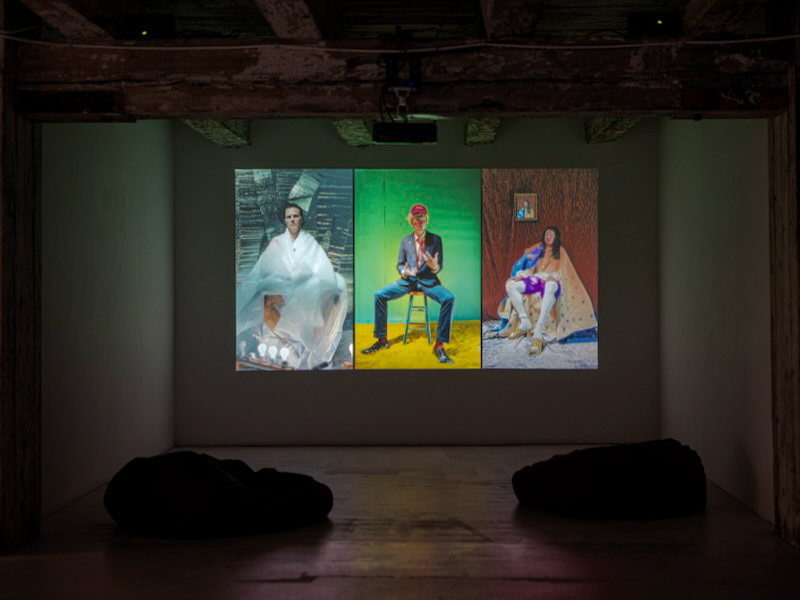
Angela Christlieb - ALL WE KNOW IS THAT WE COME FROM A PRIMORDIAL SOUP, 2026,11min
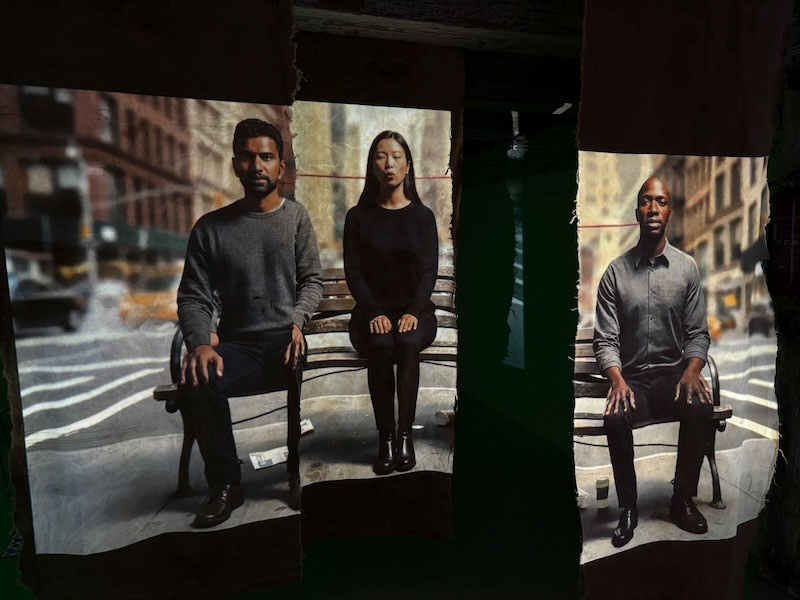
In this three-channel video installation, Angela Christlieb explores how power works today. Presented as a split-screen encounter, the work brings together three figures, the Guru, the Clown, and the Mad King, who represent different and often conflicting forms of leadership. Speaking directly to the audience, they engage in a tense and sometimes absurd dialogue shaped by moral claims, provocation, and rising emotion. What begins as a reflection slowly turns into a struggle for dominance, revealing power as fragile and performative. The Guru appears as a moral guide whose language of insight and responsibility hides rigid beliefs. The Clown uses humour and aggression to expose the emotional instability behind populist leadership. The Mad King withdraws into fantasy, showing power as isolated and disconnected from reality. Through these roles, Christlieb presents power as something deeply human, shaped by fear, vulnerability, and personal experience.
In this three-channel video installation, Angela Christlieb explores how power works today. Presented as a split-screen encounter, the work brings together three figures, the Guru, the Clown, and the Mad King, who represent different and often conflicting forms of leadership. Speaking directly to the audience, they engage in a tense and sometimes absurd dialogue shaped by moral claims, provocation, and rising emotion. What begins as a reflection slowly turns into a struggle for dominance, revealing power as fragile and performative. The Guru appears as a moral guide whose language of insight and responsibility hides rigid beliefs. The Clown uses humour and aggression to expose the emotional instability behind populist leadership. The Mad King withdraws into fantasy, showing power as isolated and disconnected from reality. Through these roles, Christlieb presents power as something deeply human, shaped by fear, vulnerability, and personal experience.
CV: Angela Christlieb studied Video Art and Experimental Filmmaking at the Academy of Fine Arts Berlin with Valie Export, Heinz Emigholz, and Elfi Mikesch. After moving to New York in 1997 with an Emerging Artist grant, she worked as an independent filmmaker and theatre manager at Anthology Film Archives and studied film production at the New School with a DAAD scholarship. Since 2001, she has collaborated with Eve Sussman & The Rufus Corporation and worked as a writer and freelance editor with artists and filmmakers including Monika Treut, Heinz Emigholz, Andrew Horn, and Christoph Schlingensief. Her films include URVILLE (2009), NAKED OPERA (premiere Berlinale 2013, Heiner-Carow Award), WHATEVER HAPPENED TO GELITIN (2014), UNDER THE UNDERGROUND (Diagonale 2019), and her recent documentary PANDORA’S LEGACY.
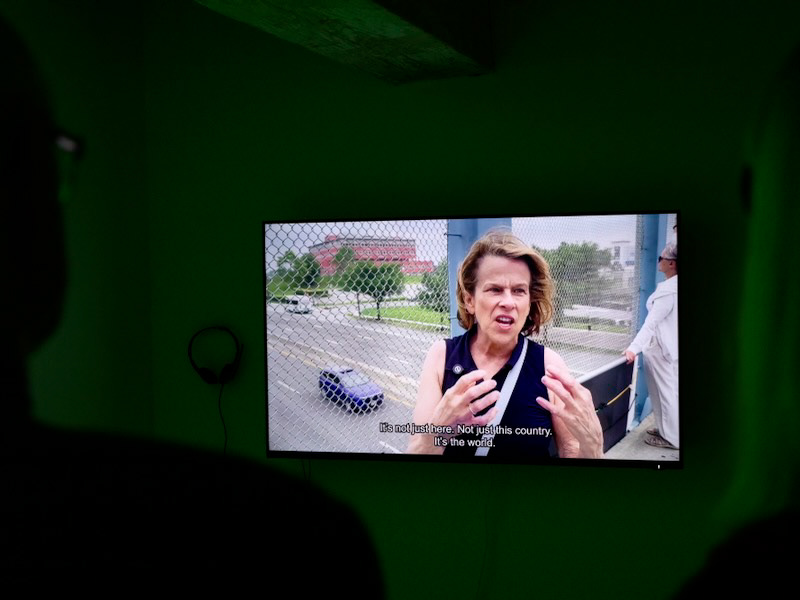
Anonymous - ACTION IS THE ANTIDOTE TO DESPAIR is a documentary (2025-26, 60 minutes) - (only @AQB) about the US-protest movement "Hands Off!" It was organised at more than 1.200 locations in all 50 states by over 150 groups, including civil rights organisations, labour unions, LGBTQ+ advocates, veterans, and election activists. The activist group "Rise and Resist" describes itself as a “nonviolent direct-action group” made up of both new and experienced activists committed to opposing any government, corporate, or other act that threatens democracy, equality, and civil liberties.
Photos by: Barnabás Neogrády-Kiss, Benedek Bognár, Holger Lang